The illustration shows boost pressure control on the 2.0L Duratorq-TDCi (DW) diesel engine
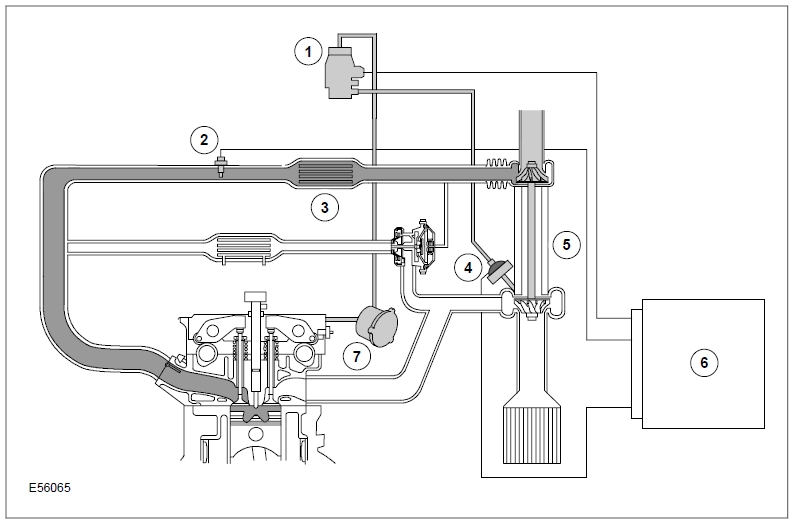
1 Boost pressure solenoid valve
2 MAP sensor
3 Intercooler
4 Vacuum unit for variable turbine geometry (with turbocharger position sensor)
5 Turbocharger(s)
6 PCM
7 Vacuum pump
On a variable turbocharger, the boost pressure is regulated by adjusting the guide vanes. This means that optimum boost pressure can be set for any operating condition.
The actual value of the boost pressure is measured by the MAP sensor and in some versions by the turbocharger position sensor as well. The set value depends on the speed and injected fuel quantity as well as the BARO.
When a control deviation occurs, the guide vanes of the variable-geometry turbocharger are adjusted via the boost pressure control solenoid valve.
In the event of a malfunction of the boost pressure control system, engine power is reduced via the fuel metering system.
Turbocharger diagnosis
Boost pressure control works as a system. The interaction of individual components (including the turbocharger) is monitored.
Malfunctions of the turbocharger and faults of the boost pressure control solenoid valve or the vacuum system for the turbocharger actuation result in increased exhaust emissions which exceed the EOBD limits. Certain faults
also lead to the EGR system being switched off. Therefore, this is a MIL active system.
Malfunctions in the boost pressure control system are detected by the MAP sensor.
In the event of a fault, the PCM limits the injected fuel quantity (power output reduction) and sets a diagnostic trouble code.
