1. MOMENTARILY NOISY WHEN CAR IS STARTED:
This condition is normal. Oil drains from the lifters which are holding the valves open when the engine is not running. It will take a few seconds for the lifter to fill after the engine is started.
2. INTERMITTENTLY NOISY ON IDLE ONLY, DISAPPEARING WHEN ENGINE SPEED IS INCREASED:
Intermittent clicking may be an indication of a pitted check valve ball, or it may be caused by dirt.
Correction: Clean the lifter and inspect. If check valve ball is defective, replace lifter.
3. NOISY AT SLOW IDLE OR WITH HOT OIL, QUIET WITH COLD OIL OR AS ENGINE SPEED IS INCREASED:
High leak down rate. Replace suspect lifter.
4. NOISY AT HIGH CAR SPEEDS AND QUIET AT LOW SPEEDS:
a. High oil level — Oil level above the “ Full” mark allows crankshaft counterweights to churn the oil into foam.
When foam is pumped into the lifters, they will become noisy since a solid column of oil is required for proper operation.
Correction: Drain oil until proper level is obtained. See PERIODIC MAINTENANCE Section.
b. Low oil level — Oil level below the “Add” mark allows the pump to pump air at high speeds which results in noisy lifters.
Correction: Fill until proper oil level is obtained. See PERIODIC MAINTENANCE Section.
c. Oil pan bent on bottom or pump screen cocked or loose; replace or repair as necessary.
5. NOISY AT IDLE BECOMING LOUDER AS ENGINE SPEED IS INCREASED TO 1500 RPM:
This noise is not connected with lifter malfunction. It becomes most noticeable in the car at 10 to 15 mph “ L” range, or 30 to 35 mph “ D” range and is best described as a hashy sound. At slow idle, it may be entirely gone or appear as a light ticking noise in one or more valves. It is caused by one or more of the following:
a. Badly worn or scuffed valve tip and rocker arm pad.
b. Excessive valve stem to guide clearance.
c. Excessive valve seat runout.
d. Off square valve spring.
e. Excessive valve face runout.
f. Valve spring damper clicking on rotator.
To check valve spring and valve guide clearance, remove the valve covers:
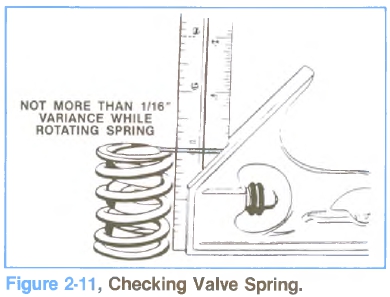
a. Occasionally this noise can be eliminated by rotating the valve spring and valve. Crank engine until noisy valve is off its seat. Rotate spring. This will also rotate valve. Repeat until valve becomes quiet. If correct is obtained, check for an off square valve spring. If spring is off square more than 1/16″ in free position, replace spring. (Figure 2-11).
b. Check for excessive valve stem to guide clearance.
If necessary, correct as required.
6. VALVES NOISY REGARDLESS OF ENGINE SPEED:
This condition can be caused by foreign particles or excessive valve lash.
Check for valve lash by turning the engine so the piston in that cylinder is on top dead center of firing stroke. If
valve lash is present, the push-rod can be freely moved up and down a certain amount with rocker arm held against valve. If OK, clean suspected valve lifters.
Valve lash indicates one of the following:
a. Worn push-rod.
b. Worn rocker arm and/or shaft.
c. Lifter plunger stuck in down position due to dirt or carbon.
d. Defective lifter.
Checking of the above four items:
1. Look at the upper end of push-rod. Excessive wear of the spherical surface indicates one of the following conditions.
a. Improper hardness of the push-rod ball. The push-rod and rocker arm must be replaced.
b. Improper lubrication of the push-rod. The push-rod and rocker arm must be replaced. The oiling system to the push-rod should be checked.
2. If the push-rod appears in good condition and has been properly lubricated, replace rocker arm and recheck valve lash.
3. If valve lash exists and push-rod and rocker arm are okay, trouble is in the lifter. Lifter should be replaced.
