AMS Operation
Function
The Variable Geometry Turbocharger (VGT) has actuated vanes in the turbine housing. The vanes modify flow characteristics of exhaust gases through the turbine housing. The benefit is the ability to control boost pressure for various engine speeds and load conditions.
The VGT is a closed loop system that uses the Exhaust Back Pressure (EBP) sensor to provide feedback to the Electronic Control Module (ECM).
The ECM uses the EBP sensor to continuously monitor EBP and adjust the duty cycle to the VGT to match engine requirements.
The VGT actuator is a control module that contains a microchip and a DC motor. The VGT actuator is located below the turbocharger. The microchip operates a DC motor which rotates a crank lever controlling the vane position in the turbine housing.
The position of the vanes is based off the pulse width modulated signal sent from the ECM.
Actuated vanes are mounted around the inside circumference of the turbine housing. A unison ring links all the vanes. When the unison ring moves, all vanes move to the same position. Unison ring movement occurs when the crank lever in the control module moves.
Exhaust gas flow can be regulated depending on required exhaust back pressure for engine speed and load. As demand for EBP increases, the ECM increases the pulse-width modulation to the VGT control module. When EBP demand decreases, the ECM decreases the duty cycle to the control module.
Actuator control for the vane position is achieved by setting a pulse width modulated signal from the ECM in response to the following:
• Engine speed
• Desired fuel quantity
• Boost
• Exhaust back pressure and altitude
The Exhaust Gas Recirculation (EGR) system controls the amount of exhaust gas being introduced to the engine mixer duct by modulating the EGR valve. The EGR actuator is located at the front of the engine on the mixer duct.
The EGR drive module controls the EGR actuator and is located on the left side of the engine on the ECM and Injector Driver Module (IDM).
The ECM calculates the appropriate desired EGR valve position in response to the changing engine speed, fuel desired, operator demand, engine operating temperatures, exhaust back pressure, boost pressure and altitude. The ECM uses sensor input from the following:
• Variable Geometry Turbocharger (VGT) actuator
• Accelerator Position Sensor (APS)
• EGR actuator with position sensors
• EGR drive module
• Exhaust Back Pressure (EBP) sensor
• Manifold Absolute Temperature (MAT) sensor
• Barometric Absolute Pressure (BAP) sensor
• Engine Coolant Temperature (ECT) sensor
• Engine Oil Temperature (EOT) sensor
• Manifold Absolute Pressure (MAP) sensor
The EGR drive module provides feedback to the ECM on the valve position. The EGR drive module interprets the ECM command and sends the command using three pulse width modulated signals to the valve actuator.
The system is closed loop control using the EGR position signals. The EGR drive module provides a 9 V supply and ground to the Integrated Circuit (IC) in the motor of the valve. When the EGR drive module directs the valve to move, the IC with three Hall effect sensors provides the EGR drive module with the valve position signals. The EGR drive module interprets the three signals to determine valve position and sends the information back to the ECM.
Fault Detection / Management
The ECM continuously monitors the Air Management System (AMS). When the ECM detects a fault in the
any of the interdependent systems, the ECM will set a DTC and illuminate the amber ENGINE lamp.
The Variable Geometry Turbocharger (VGT) is continuously monitored by the ECM using the exhaust back pressure and the VGT pulse-width modulated signal’s duty cycle. A DTC is logged when the ECM determines that the duty cycle required to reach the desired boost or exhaust back pressure is greater or less than the ECM’s pre-programmed expected values.
The Exhaust Gas Recirculation (EGR) actuator is continuously monitored by the EGR drive module. When an EGR control error is detected, the EGR drive module sends a message to the ECM, a DTC is set, and the amber ENGINE lamp is illuminated. For additional function and operational information, see “EGR Actuator” (page 413).
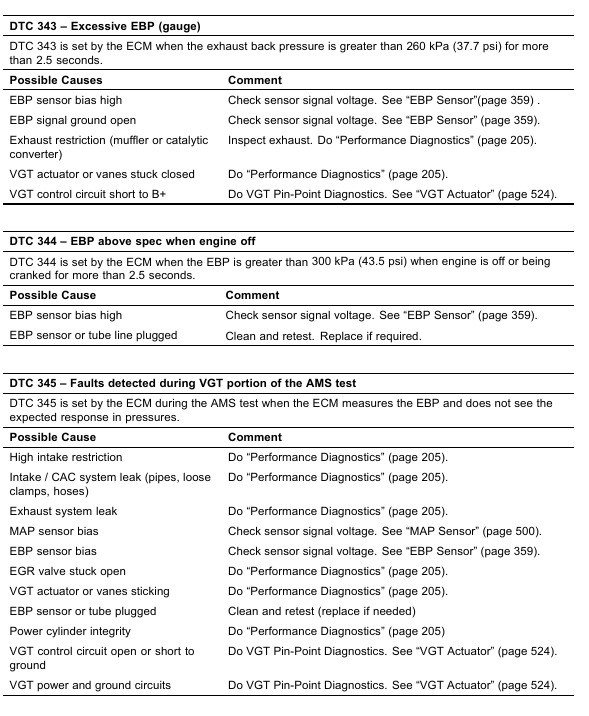
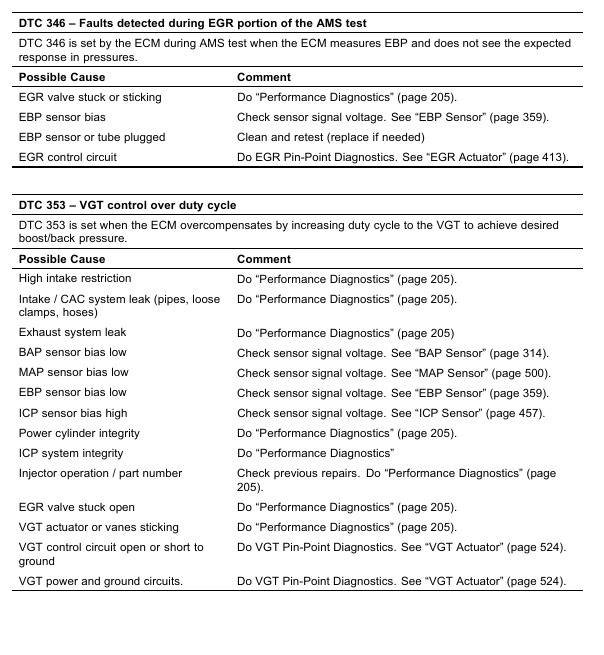
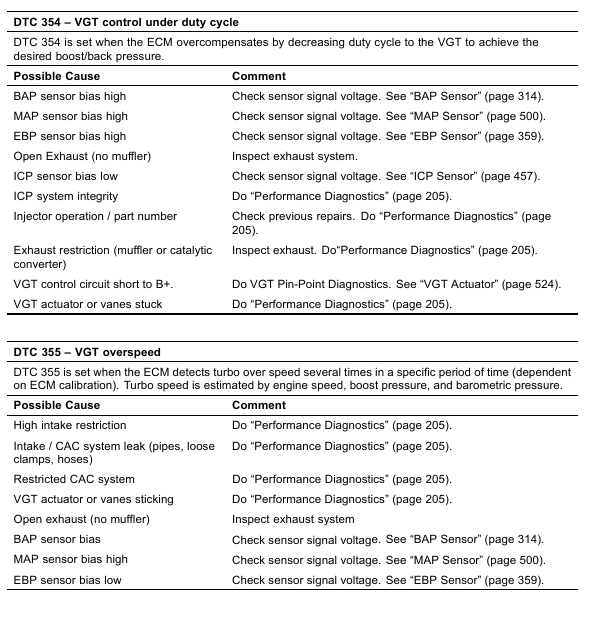
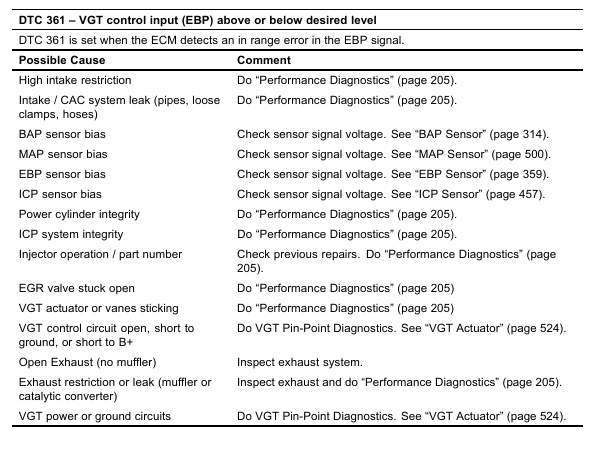
AMS Diagnostic Trouble Codes (DTCs)
DTCs are read using the Electronic Service Tool (EST) or by counting the flashes from the amber and red
ENGINE lamp.
NOTE: Before proceeding make sure all sensor, injector and actuator electrical DTCs have been repaired. Follow the procedures outlined in Section 6 or Performance Diagnostics form.