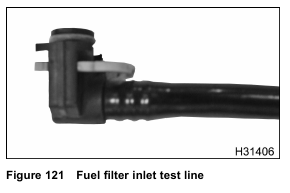
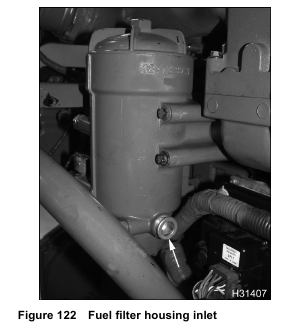
1. Disconnect the supply line from the fuel filter housing.
2. Make a test fuel line.
• Use a 90° fuel line male fitting and install a clear plastic line that is long enough to reach an alternative fuel source.
NOTE: The mechanic is expected to keep the fuel test line for future diagnostics. Expense the fuel test line as an essential tool and keep it with other diagnostic tools. Warranty will not cover the cost of the fuel test line.
3. Connect the alternate fuel source to the fuel filter housing inlet.
4. Start or crank the engine for 20 seconds. Measure fuel pressure with the shut-off valve closed. Open the shut-off valve to check for aeration.
NOTE: Breaking any fuel system joint will induce air into the fuel system. The air should pass in a short period of time. As fuel pressure is relieve, a steady stream of fuel without air bubbles indicates the fuel is not aerated.
NOTE: If a fuel pressure gauge with shut-off valve and clear 3/8” diameter hose is not available, refer to the alternative test “Checking for Aerated Fuel using Spare Fuel Line.”
• If the fuel pressure is in specification and the fuel is not aerated, repair the leak between the fuel filter housing and the fuel tank.
• If the fuel is aerated, repair or replace the fuel filter housing.
