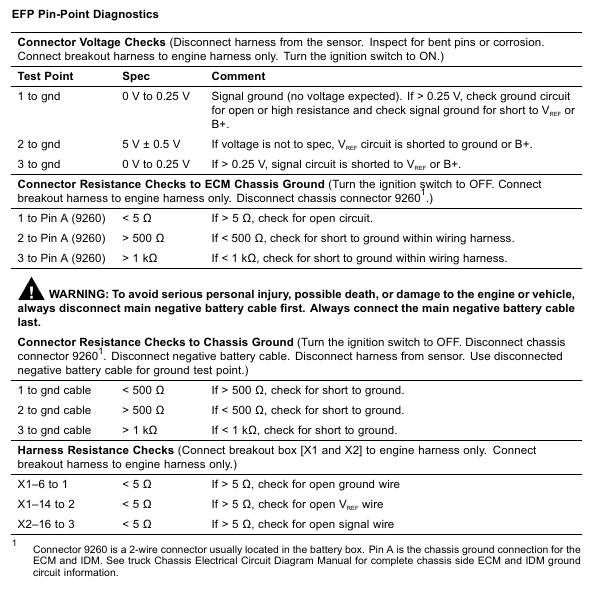
The EFP sensor is supplied with a 5 V reference voltage at Pin 2 from ECM Pin X1–14. The EFP
sensor is grounded at Pin 1 from ECM Pin X1–6. The EFP sensor returns a variable voltage signal from Pin
3 to ECM Pin X2–16.
Fault Detection / Management
The ECM will ignore the EFP signal when the signal is detected to be out of range or an incorrect value is read.
EFP Diagnostic Trouble Codes (DTCs)
DTCs are read using the EST or by counting the flashes from the amber and red ENGINE lamp.
DTC 136
EFP signal out-of-range low
• DTC 136 is set by ECM when the EFP signal is less than 0.039 V for more than 0.35 second.
• DTC 136 can be set due to an open or short to ground on the signal circuit, a failed EFP sensor or an open VREF circuit or VREF short to ground.
• When DTC 136 is active the amber ENGINE lamp is not illuminated.
DTC 137
EFP signal out-of-range high
• DTC 137 is set by the ECM when the EFP signal is greater than 4.9 V for more than 0.35 second.
• DTC 137 can be set due to a signal circuit short to VREF or B+ or a failed EFP sensor.
• When DTC 137 is active the amber ENGINE lamp is not illuminated.
DTC 371
EFP is above normal operating range
• DTC 371 is set by ECM when measured fuel pressure is greater than expected pressure by 100 kPa (15 psi) for more than 60 seconds.
• DTC 371 can be set due to debris in fuel regulator valve, failed fuel regulator valve, open signal ground, VREF shorted to a voltage source greater than 5.5 V, bias high circuit, or failed EFP sensor.
• When DTC 371 is active the amber FUEL FILTER lamp will not illuminate
DTC 372
EFP is below normal operating range
• DTC 372 is set by ECM when measured fuel pressure is less than expected pressure by 103 kPa (15 psi) for more than 30 seconds.
• DTC 372 can be set due to dirty fuel filter element, fuel inlet restriction, debris in fuel tank, debris in fuel regulator valve, failed fuel regulator valve, failed fuel pump, bias low circuit, or failed EFP sensor. See “Fuel Pressure and Aerated Fuel” – Section 6.
• When DTC 372 is active the amber FUEL FILTER lamp is illuminated.
Tools
• EST with MasterDiagnostics® software
• EZ-Tech® interface cable
• Digital Multimeter (DMM)
• 3-Banana Plug Harness
• 500 Ohm Resistor Harness
• Breakout Box
• Breakout Harness
• Terminal Test Adapter Kit
EFP Operational Diagnostics
1. Using EST, open the D_ContinuousMonitor.ssn.
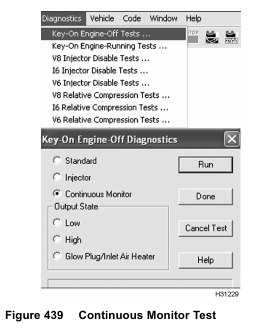
2. To monitor signal voltage, run KOEO Continuous Monitor Test. For help, see “Continuous Monitor
Test” in Section 3 (page 68).
3. Monitor EFP signal voltage. Verify an active DTC for the EFP circuit.
4. If code is active, do step 6 and 7 to check circuit for the EFP sensor using the following table.
• Circuit Checks for EFP Sensor
5. If code is inactive, wiggle connectors and wires at all suspected problem locations. If circuit continuity is interrupted, the EST display DTCs related to the condition.
6. Disconnect engine harness from pressure sensor.
NOTE: Inspect connectors for damaged pins, corrosion, or loose pins. Repair if necessary.
7. Connect Pressure Sensor Breakout Harness to engine harness only.