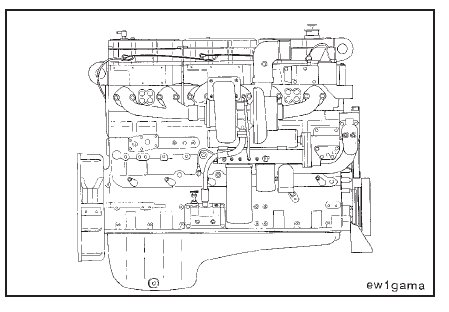
Measurements from these indicators and gauges must be observed closely during all phases of the engine run-in
period. Engine measurements taken are:
• Engine speed
• Engine torque
• Lube oil pressure
• Coolant out temperature
• Fuel pressure
• Crankcase blowby
• Fuel rate (using Part No. 3376375)
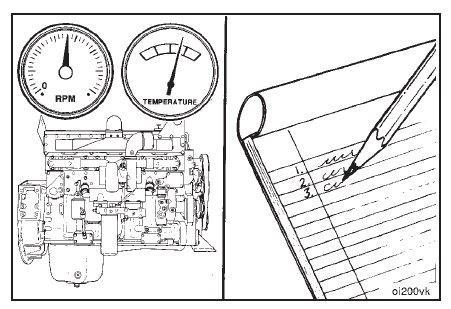
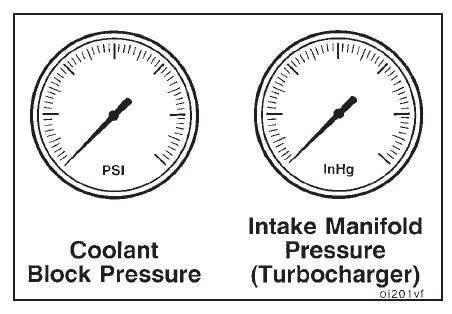
To correctly evaluate the engine performance, this additional measurement, intake manifold pressure (turbocharger boost), must be observed during engine run-in phases.
Refer to the Engine Dynamometer worksheet on the last page of this procedure.
NOTE: It is recommended to monitor block coolant pressure during run-in to aid in early indication of a cooling system problem.
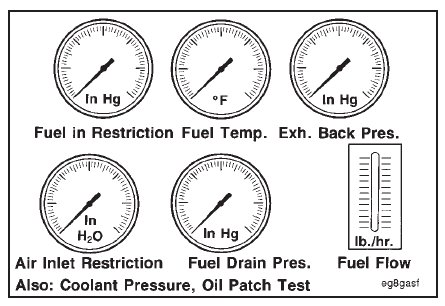
It is a good practice to observe these measurements even if engine performance meets specifications. If engine
performance does not meet specifications, these measurements can indicate possible reasons for
underperformance. The measurements taken are:
• Fuel inlet restriction at fuel pump inlet
• Fuel temperature
• Exhaust system back pressure
• Air inlet restriction pressure
• Fuel drain pressure
• Coolant pressure
• Oil patch test
• CompulinkTM for CELECTTM equipped engines
Obtain the CPL number from the engine data plate and the fuel pump code from the fuel pump data plate. Engine
performance specifications and fuel system calibration values for specific engine CPL and fuel pump codes are
listed in the following publications:
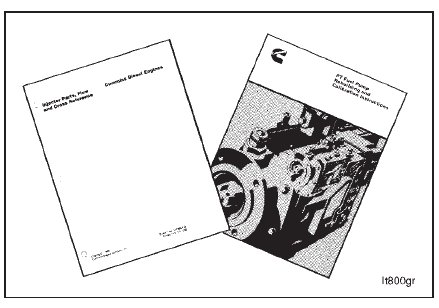
1. Fuel Pump Calibration Values, Bulletin No. 3379352.
2. Injector Parts Flow and Cross Reference, Bulletin No. 3379664.
3. Engine Data Sheets.
4. N14 Troubleshooting and Repair Manual, Bulletin No. 3810456.
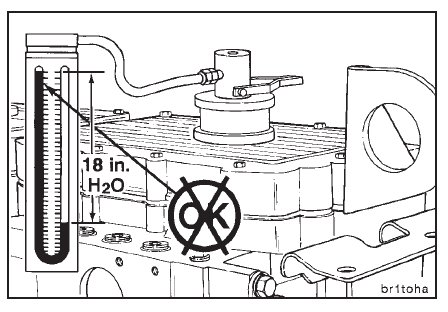
If a sudden increase in blowby occurs, or if blowby exceeds the maximum allowable limit during any run-in
step, return to the previous step and continue the run-in.
If blowby does not reach an acceptable level during the next step, discontinue the run-in and determine the cause.
Do not proceed to the next step until a steady blowby reading is obtained.
NOTE: Blowby must be measured by using Service Tool, Part No. 3375150 or 3822566, with manometer, Part No.
ST-1111-3, or equivalent. Service Tool, Part No. 3375150, as shown, utilizes a chamfered 7.67 mm [0.302 in] orifice.
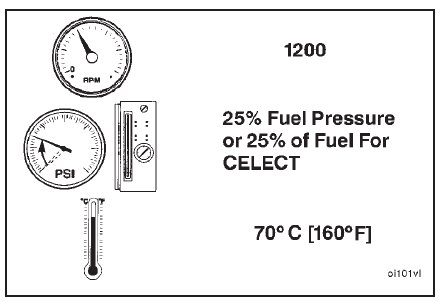
Start the engine.
Move the throttle to obtain 1200 RPM engine speed, and apply a test load sufficient to develop 25 percent rated
fuel pressure or 25 percent fuel rate on CELECTTM engines.
Operate the engine at this speed and load level until the coolant temperature is 70°C [160°F]. Check all gauges
and record the data.
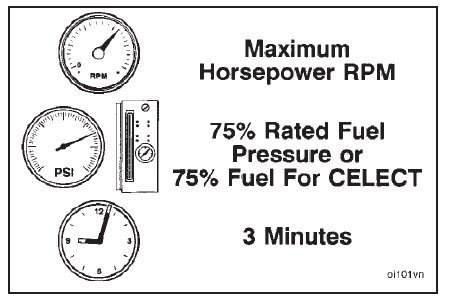
Open the throttle to obtain speed at which maximum horsepower is developed and adjust the dynamometer
load to achieve 75 percent of rated fuel pressure or 75 percent fuel rate on CELECTTM engines. Operate the engine at this speed and load level for 3 minutes.
Check all gauges and record the data.
NOTE: Do not proceed to the next step until blowby is stable within specifications.
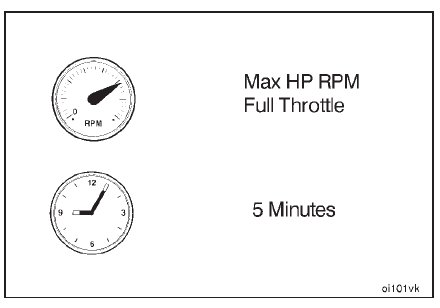
Maintain maximum horsepower RPM and advertised horsepower, and increase the dynamometer load until
100 percent rated fuel pressure or 100 percent fuel flow is developed. Operate the engine at this speed and load
level for 5 minutes or until the blowby becomes stable within specifications.
Check all gauges and record the data.
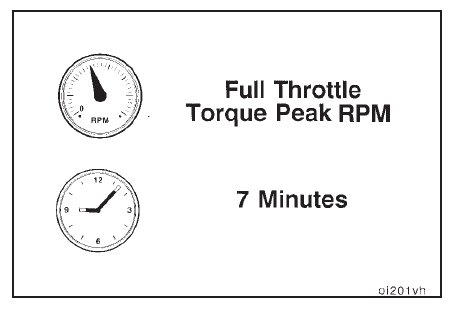
Increase the dynamometer load until the engine speed reduces to the engine’s torque peak RPM.
Operate the engine at torque peak RPM for 7 minutes.
Check all gauges and record the data.
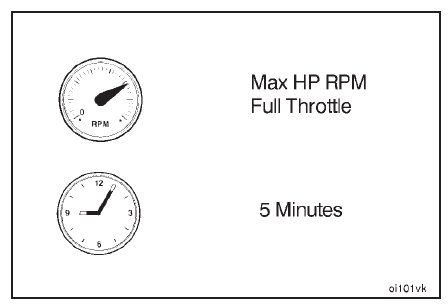
Reduce the dynamometer load until the engine speed increases to the engine’s maximum horsepower RPM.
Operate the engine at maximum horsepower RPM for 5 minutes.
Check all gauges and record the data.
Compare the readings to the specifications listed in the previously mentioned publications.
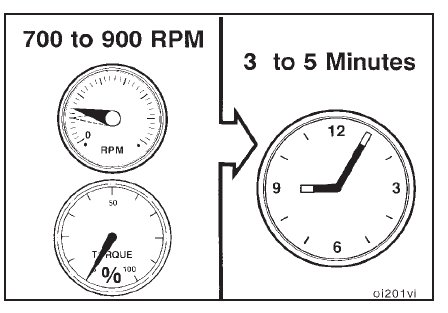
Remove the dynamometer load completely, and operate the engine at 700 to 900 RPM for 3 to 5 minutes. This
period will allow the turbocharger and other components to cool.
Shut off the engine.
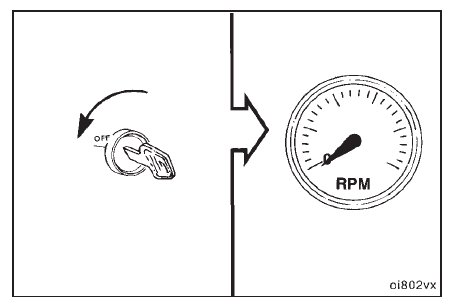
Make sure all instrumentation is removed before removing the engine from the engine dynamometer.